

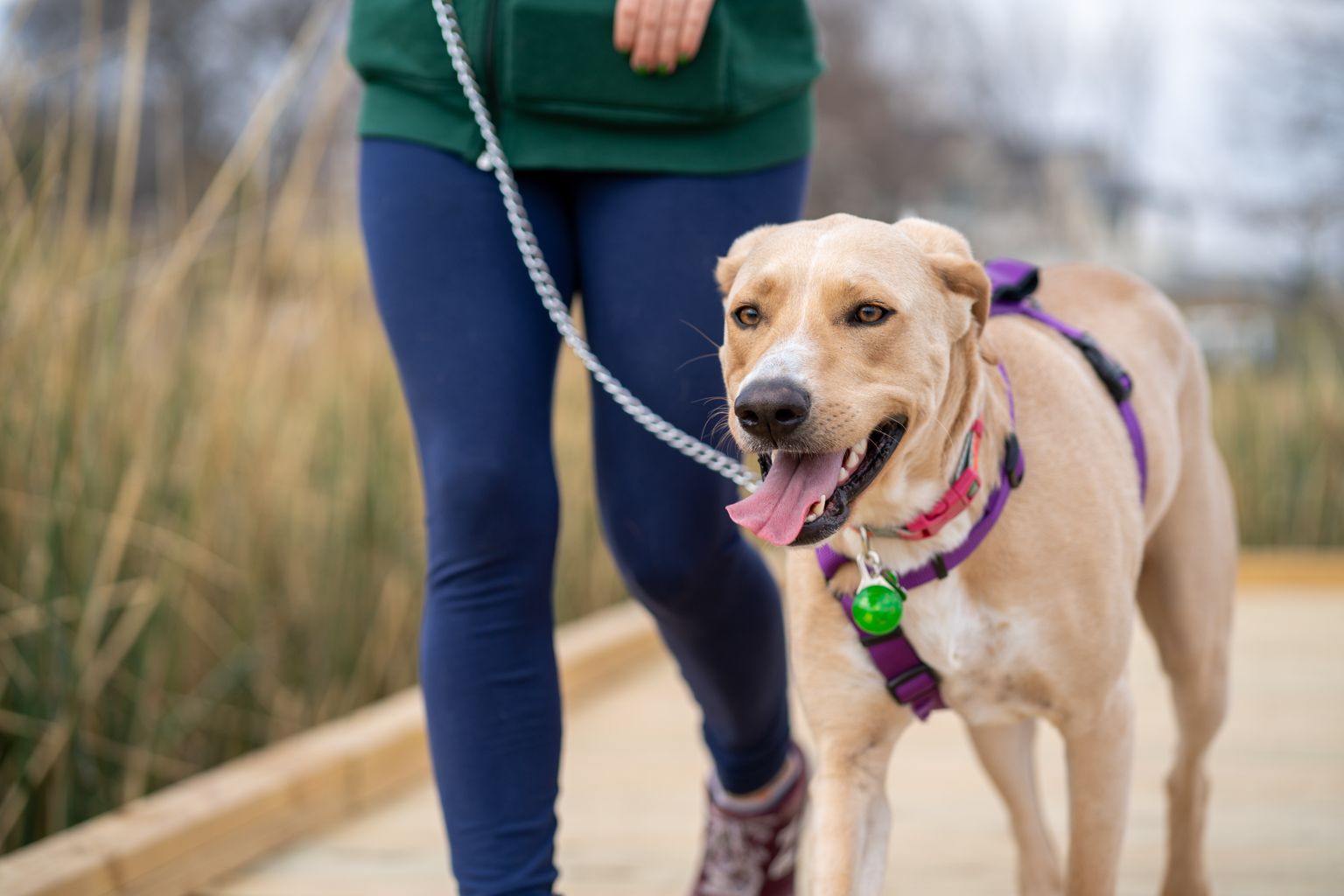
Your dog spots a squirrel, the leash snaps tight, and you’re suddenly jogging down the block with one arm stretched out in front of you. Dog leash training fixes that by teaching your dog that pulling stops the walk and a slack leash keeps it going. You reward your dog for staying close, stop the moment the leash tightens, and add distractions a little at a time.
The plan below uses rewards only, with gear you may already own. It works for a puppy on its first night home and for an adult rescue that has pulled for years. Every step also tells you the sign that your dog is ready for the next one, so you never have to guess.
Quick answer: Dog leash training means teaching your dog that a slack leash makes the walk keep going. Use a 6-foot leash and a harness or flat collar. Reward your dog for staying near you, and stop or turn whenever the leash goes tight. Keep sessions short and add distractions slowly.
This blog is general information and is not veterinary advice. Talk to your vet about your dog’s health and behavior. Read our full disclaimer.
These steps follow the loose-leash guidance published by the AKC and two humane societies, checked in November 2026, plus what owners report in active puppy-training forums.
What is dog leash training, and what does a loose leash mean?
Dog leash training teaches your dog to walk near you on a relaxed leash that hangs in a soft “J” shape between your hand and the clip. A loose leash keeps a little droop the whole time, with no pressure on your dog’s neck or chest.
A trip to the mailbox doesn’t call for a show-ring heel. The American Kennel Club treats formal heeling as a separate, advanced skill for Obedience and Rally. Everyday loose-leash walking only asks your dog to stay at or near your side without pulling.
Your dog still gets plenty of freedom to drift a little ahead, switch sides or pause to sniff, as long as the leash stays slack. Animal Humane Society suggests two kinds of walk: a formal cue for busy sidewalks, and a relaxed “off-duty” walk whose only rule is no pulling forward.
When should you start leash training a puppy or dog?
Start the day your puppy comes home, indoors, before any real walks. The AKC says you can begin even if your puppy hasn’t finished their vaccines, and adult dogs can learn at any age.
So, at what age should a dog be leash trained? There’s no minimum age for indoor practice. A young puppy can wear a light harness, learn a marker word and follow you down the hallway for treats long before it sets a paw on the sidewalk.
Until your puppy is protected, keep practice to your home and your own fenced yard. Outdoor timing depends on where your puppy is in its pet vaccinations schedule, so ask your vet when public sidewalks and parks are safe.
Older dogs learn the same way. A 6-year-old rescue can pick up loose-leash walking with these seven steps, though the old pulling habit takes more repetitions to replace.
What gear do you need for dog leash training?
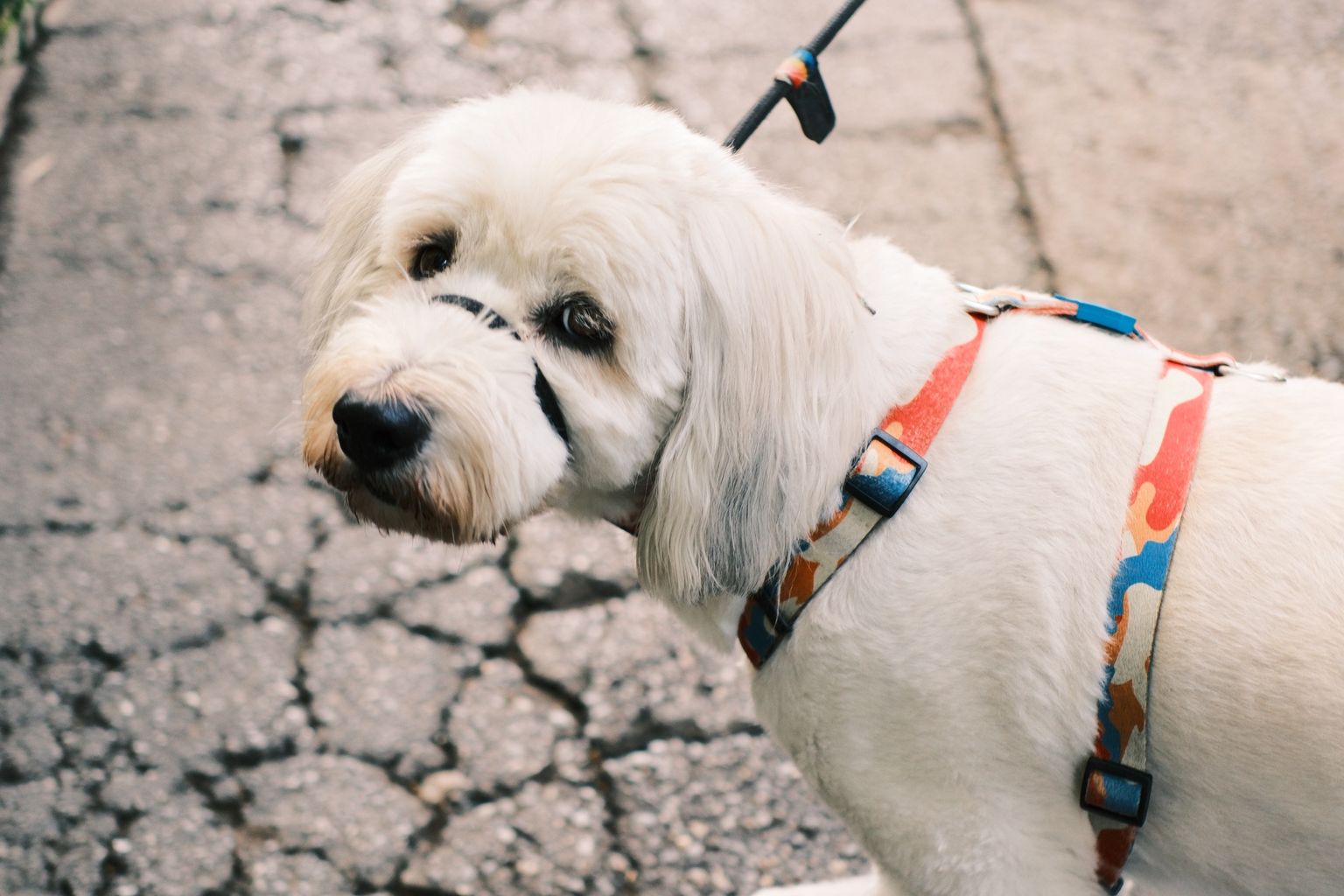
You need a 6-foot leash, a harness or flat collar that fits well, and a pocket full of small, soft treats. Everything else is optional. Bring everyday treats plus a few high-value ones, like bits of plain cooked chicken, for harder moments outside.
| Gear | What it does | Good for | Skip if |
|---|---|---|---|
| 6-ft standard leash | Gives slack for a relaxed J-curve while keeping your dog close | Every dog and every step | You prefer shorter; Animal Humane Society says 4 ft also works |
| Flat collar | Carries ID tags and a leash clip | Dogs that already walk calmly | Your dog pulls hard, since pressure lands on the neck |
| Back-clip harness | Clips between the shoulders and spreads pressure across the chest | Puppies and small, calm walkers | Your dog is a strong puller |
| Front-clip harness | Clips at the chest, so a pull turns your dog toward you | Large puppies (AKC’s pick) and pullers | It rubs behind the front legs or limits shoulder movement |
| Head halter (optional) | Guides the head, and the body follows | Strong dogs, introduced slowly with treats | Your dog hasn’t had a gradual introduction |
| Treat pouch | Keeps treats at your hip for fast rewards | Every session | Your jacket pocket works fine |
| Long line | Gives room to roam while still attached | Sniff walks in open, safe spaces | You’re near traffic or crowds |
| Retractable leash | Lets out more line when your dog pulls | Nothing during training | You’re teaching loose-leash walking; the AKC advises avoiding them |
Pain-based tools such as prong, choke and shock collars aren’t part of this method. The American Veterinary Society of Animal Behavior recommends reward-based training for all dogs and advises trainers to avoid tools that work through pain.
How to leash train a dog in 7 steps
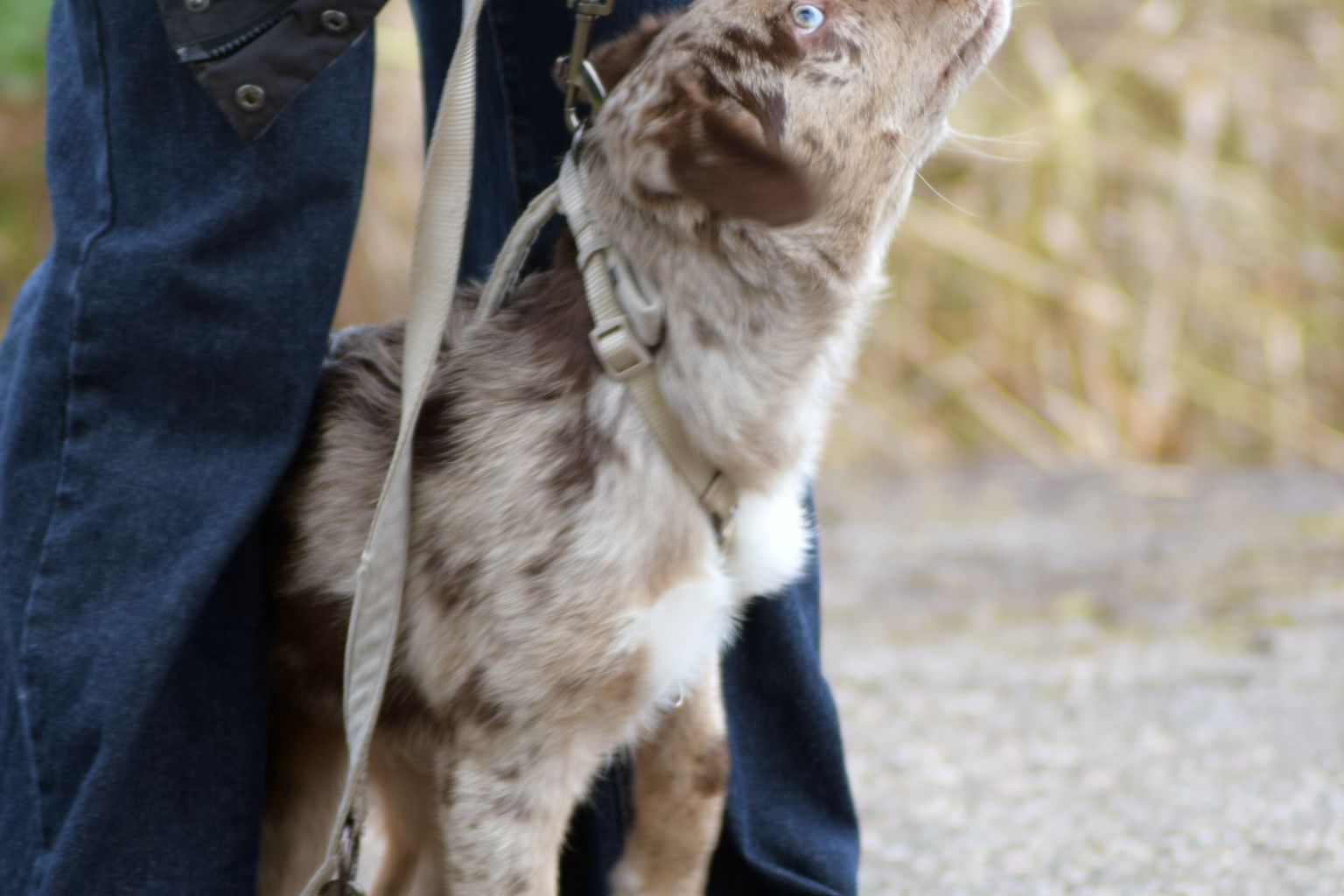
Work through these seven steps in order. Each one has three parts: what to do, the sign your dog is ready to move on, and the mistake that most often stalls progress. If things fall apart, go back one step.
Step 1: Teach a marker word
What to do: In a quiet room, say “yes” (or press a clicker) and hand your dog a treat right away. Repeat until the sound clearly means food is coming. The AKC suggests starting here, before the leash comes out. Count training treats toward your pup’s daily food, and use pieces of their regular puppy food for small breeds when you can, so meals stay balanced.
Move on when: Your dog’s head turns toward you every time they hear “yes,” even when they were looking elsewhere.
Common mistake: Saying “yes” with no treat ready. The marker is a promise, and breaking it teaches your dog to ignore the word.
Step 2: Get your dog comfortable with the collar, harness and leash
What to do: Put the harness or collar on for short stretches indoors, treating as it goes on and while your dog wears it. Then clip on the leash and let it trail behind while you watch, so your dog learns the leash is boring. Only let it drag under supervision, because it can snag on furniture.
Move on when: Your dog walks over happily when the harness comes out and ignores the trailing leash.
Common mistake: Getting the fit wrong. The AKC says a harness should be snug enough that your puppy can’t slip out, while still letting them move freely. A pinching harness makes walk time something to dread.
Step 3: Reward check-ins and eye contact
What to do: With the leash clipped on indoors, mark and treat every time your dog looks at you on their own. If your dog never looks up, San Diego Humane Society suggests making a fun sound and rewarding any glance, even an ear flick your way. Add the AKC’s leash-end check-in too: when your dog reaches the end of the leash, say their name, mark the look back, and reward them when they return.
Move on when: Your dog checks in over and over without being asked, and turns back when they hear their name.
Common mistake: Rewarding only when you ask for attention. Check-ins your dog offers freely are the habit you want on real walks.
Step 4: Add a “Let’s go” cue and walk a few steps
What to do: Pick a cue like “Let’s go” or “With me.” Say it, take one step, stop, and feed a treat right beside your leg, along the seam of your pants. Animal Humane Society uses this feeding spot to show your dog exactly where “beside you” is. Build to two steps, then more between treats. Before a turn, say your dog’s name, then a cue like “turn,” and reward as they follow.
Move on when: Your dog stays near your side for several steps in a row and follows your turns indoors or in the yard.
Common mistake: Handing treats out in front of you or up at your chest. Your dog goes wherever the food shows up, so deliver it at your side.
Step 5: Stop or turn when the leash goes tight
What to do: The instant the leash tightens, stand still like a tree. When it goes slack, walk on, or turn and head the other way. Animal Humane Society adds a smart detail: when your dog comes back, take two or three steps before you treat. Otherwise your dog learns a sneaky chain of pull ahead, come back, get a snack.
To practice, try San Diego Humane Society’s Red Light/Green Light game. Put a small pile of treats 4 to 5 feet away, walk toward it only while the leash is loose, and stop the moment it tightens.
Move on when: Your dog reaches the treat pile on a loose leash and starts easing off on their own when the leash tightens.
Common mistake: Yanking or popping the leash. It hurts, and it gives your dog no information about where to walk.
Step 6: Move outside and add distractions slowly
What to do: Start on the quietest street you can find, at the quietest time of day. Bring higher-value treats than you use indoors, as the AKC suggests, and repeat Steps 3 to 5 outside. When something big shows up, like a dog across the street, add distance before you ask for focus. Animal Humane Society suggests calling your dog’s name and heading the other way if they lock onto a person or animal.
Move on when: Your dog walks loosely and checks in on the quiet street, so you can try a slightly busier block.
Common mistake: Jumping straight to the dog park on a Saturday morning. That leap in distractions is too big, and pulling wins.
Step 7: Give sniff breaks on cue and keep sessions short
What to do: Teach a release cue like “go sniff” or “free time,” and give it as a reward after a stretch of nice walking. Michele Miller, a CPDT-KA trainer quoted by the AKC, recommends sniffy walks several times a week where your puppy picks the route. Keep sessions short and stop while your dog is still getting it right. Owners in r/puppy101 whose puppies had gone off walks say turning part of each walk into a sniff trip brought the fun back.
Move on when: Your dog comes back to your side when you give your walk cue after a sniff break. From here, it’s practice.
Common mistake: Training until your dog is tired and frustrated. A short session that ends on a win teaches more than a long one that ends in a tug-of-war.
How do you stop a dog from pulling on the leash?
Pulling works for your dog because it gets them to the smell, the person or the other dog faster. To stop it, make pulling end the walk every single time, and make a slack leash the only way forward.
San Diego Humane Society explains that dogs pull because pulling earns real rewards, like sniffing a bush or greeting a friend. Owners in r/puppy101 put the fix as a two-part rule: a tight leash means stop, and a relaxed leash means go. If you’ve been asking, “How do I get my dog to stop pulling on the leash?”, these habits make that rule stick:
- Be consistent. One walk where pulling gets your dog to the hydrant teaches them to keep trying. AKC trainer Michele Miller says a common problem is owners “not telling our dogs what we do want,” so reward the slack leash as often as you stop for the tight one.
- Pay for position. Early on, treat often at your side, so next to you becomes the best-paying spot on the street.
- Try a front-clip harness. It adds steering while training does the work. Owners in r/dogs note that no harness stops pulling on its own.
- Take the edge off first. A quick game of fetch or tug in the yard helps a bouncy dog focus.
- Use the same rules in the whole house. If one person lets the dog drag them to the park, your dog learns that pulling sometimes pays.
- Fix turn fatigue with a hand target. Owners in r/Dogtraining worn out by constant U-turns had better luck teaching “touch,” where your dog bumps their nose to your palm held at your side.
What are the most common dog leash training problems?
Most leash problems mean the walk is harder than your dog’s current skill level. Make it easier with more distance, better treats or a quieter place, then build back up.
| Problem | Likely cause | What to try |
|---|---|---|
| Lunging at dogs or people | The trigger is too close, and your dog is excited or worried | Cross the street or turn away, then reward looks at you. If it keeps happening, see the trainer advice below. |
| Biting or chewing the leash | Play, teething or frustration | Get attention with a treat, say “drop,” and reward when the leash leaves their mouth (AKC). Keep less slack, and offer one of the dog toys for chewers to carry instead. |
| Sitting down or refusing to walk | Unsure about the leash or place, tired, or possibly sore | Skip the tugging. Stand still and mark any step toward you, as r/puppy101 owners suggest. A sudden refusal needs a vet check. |
| Zig-zagging in front of you | Sniffing, or unsure where to walk | Reward more often at your side, and give the walk cue before moving. |
| Pulling toward smells | Sniffing is your dog’s biggest reward | Use “go sniff” as payment for loose walking (Step 7). |
| Barking at triggers | Fear or frustration at that distance | Add distance and reward calm looks. If it doesn’t improve, talk to a trainer or your vet. |
How do you leash train an adult or rescue dog?
Use the same seven steps, but start farther away from triggers and expect old pulling habits to take longer to change. An adult dog has had years of practice, and every walk where pulling got them somewhere counted as a lesson.
A rescue may also come with fears you don’t know about yet. New streets or traffic noise can make one dog freeze and another bolt to the end of the leash. Start in the quietest, most familiar places you have, even if that’s a hallway for a while.
Build trust before you build skills. Hand-feed some meals, keep early walks short and easy, and let your dog settle in before you push for polished walking. A front-clip harness is worth trying for a strong adult who pulls. Celebrate small wins, like one loose block, because they add up.
How long does leash training take?
There’s no set timeline. It depends on your dog’s age, history and how often you practice, and the AKC notes that loose-leash walking around distractions can take time for puppies to fully understand.
As general advice, short sessions most days work better than one long session on the weekend. Dogs learn through frequent, easy repetitions, and a tired dog stops learning.
Track progress signs on your walks. More check-ins, a faster return to slack after a stop, and calm walks on busier streets all mean you’re moving forward.
When should you call a trainer or your vet?
Call a certified trainer, such as one with the CPDT-KA credential, or a veterinary behaviorist if lunging, growling or barking doesn’t improve with more distance and better treats. Getting help early often stops bad habits before they set in.
See your vet first if your dog suddenly refuses walks, starts limping, or yelps or flinches when the harness goes on. Coughing or gagging when the collar tightens is another reason for a check. Any of these can point to pain, so get your dog examined before you keep training.
The bottom line
Teach a marker, get your dog comfortable in their gear, reward check-ins, add a “Let’s go” cue, stop when the leash goes tight, add distractions slowly, and pay with sniff breaks. All seven steps teach your dog the same lesson, that a slack leash keeps the walk going, and it’s the kind of everyday dog care skill that makes every outing easier.
Expect wobbles along the way, especially on exciting days, and drop back a step whenever you need to. If you’re raising a new puppy, the same calm, reward-based approach works when you crate train a dog, a natural next skill, and the same habits carry into other training and travel moments, from car trips to everyday manners.
Frequently Asked Questions
What is the fastest way to leash train a dog?
There’s no shortcut that sticks. Short sessions most days, high-value treats and a firm rule that pulling never pays off will get you there fastest. Skipping steps usually costs time, because your dog falls back on pulling when the walk gets too hard.
What is the 7 7 7 rule for dogs?
It’s an informal guideline some trainers and vet clinics use, with two common meanings. One is puppy socialization: seven kinds of new experiences, like surfaces, objects and people. The other describes how a rescue adjusts over seven days, weeks and months. Neither is a leash-training method.
Should I use a harness or a collar for leash training?
Either works if it fits well. The AKC says a harness is generally a better option for puppies because it keeps pressure off the neck, and it recommends a front-clip harness for large puppies. For a dog that already pulls, a front-clip harness gives you more steering.
Are retractable leashes bad for leash training?
Yes, during training. A retractable leash lets out more line whenever your dog pulls, so pulling gets rewarded on every walk. The AKC advises avoiding them and using a lightweight 6-foot leash. For extra freedom, use a long line in open, safe areas.
How often should I practise leash training?
Practice in short sessions most days, and stop while your dog is still getting it right. Everyday moments count too, like the walk to the mailbox or a potty break in the yard. Frequent, easy wins teach more than one long, frustrating session.
Is it okay to let my dog sniff on walks?
Yes. Sniffing is great enrichment and one of your dog’s favorite rewards. Use a release cue like “go sniff” to pay for loose walking, and plan regular sniffy walks where your dog chooses the direction, as the AKC’s trainer suggests for puppies.
Can you leash train a dog that is already a puller?
Yes. Use the same seven steps with extra consistency, so pulling never gets your dog anywhere. A front-clip harness can help with steering while the new habit forms. The pulling section above covers the habits that make the biggest difference.
Should I use a prong or choke collar to stop pulling?
They’re not recommended. The American Veterinary Society of Animal Behavior recommends reward-based methods for all dog training and advises against tools that work through pain, including prong, choke and shock collars. A front-clip harness plus the stop-and-wait method reduces pulling without pain.