
Disclaimer: This guide is for general information only and isn’t a substitute for advice from your veterinarian. Products mentioned are for reference only, so check with your vet before changing your puppy’s diet.
The best puppy food for small breeds is a complete and balanced small-breed or toy-breed puppy formula. Look for an AAFCO statement for growth, a named animal protein near the top of the ingredient list, added DHA, small kibble, and about 400+ calories per cup. Feed it in 4 or more small meals a day until about 4 months of age.
Choosing the right bag is only half the job. A 3-pound Yorkie puppy burns energy fast, has a stomach about the size of a walnut, and can slip into low blood sugar if it misses a meal. That’s why how much and how often you feed matter just as much as what goes in the bowl. This guide covers what to check on the label, which feeding tools make life easier, how much and how often to feed, and when to switch to adult food.
What makes the best puppy food for small breeds?
| What to check | What to look for | Why it matters |
|---|---|---|
| AAFCO statement | “Complete and balanced for growth” or “all life stages” | Adult-only foods lack the extra protein, fat, and minerals puppies need. |
| First ingredients | A named protein: chicken, lamb, turkey, salmon, or chicken meal | Protein builds muscle. Terms like “meat by-products” hide the source. |
| DHA | DHA listed, or fish oil in the ingredients | Supports brain and eye development. |
| Calcium : phosphorus | Roughly 1:1 to 2:1 | An imbalance can affect bone growth. |
| Kibble size | About pea-sized or smaller | Toy puppies may choke on big pieces or give up chewing. |
| Calories | Usually 400+ kcal/cup | Tiny stomachs need energy in every bite. |
| Who makes it | Veterinary nutritionist on staff, feeding trials, quality control | The WSAVA and AKC suggest asking makers these questions. |
If a food passes every row, it’s a strong candidate. If it fails the first row, put it back.
Why small-breed puppies need different food
They burn more calories per pound. Small dogs have faster metabolisms. A 4-pound Chihuahua puppy needs nearly twice as many calories per pound as a 40-pound Lab puppy, yet its stomach holds only a few tablespoons. That’s why small-breed formulas are energy-dense and why meals are split up through the day.
They have small mouths and sore gums. Baby teeth fall out at around 12–16 weeks. Standard kibble can be too big or hard for a toy puppy, and owners often mistake a sore mouth for picky eating. If your puppy drops pieces or chews on one side, try a smaller kibble or soften it with warm water.
They grow up fast. Most small breeds reach adult size by 9–12 months, compared with 18–24 months for giant breeds. That fast growth needs steady nutrition with no long gaps.
They have little fuel in reserve. Tiny puppies carry little body fat and stored sugar. A large-breed puppy can coast through a missed meal. A toy puppy may not.
Watch for low blood sugar (hypoglycemia)
- Most at risk: Puppies under about 5 lb in their first 3–4 months, especially Chihuahuas, Yorkies, Maltese, Pomeranians, and toy Poodles. Cold, stress, missed meals, vomiting, diarrhea, and long play sessions raise the risk.
- Signs: Wobbliness, trembling, a dazed look, unusual sleepiness, cold body, refusing food, and in severe cases collapse or seizures.
- What to do: If the puppy can swallow, rub a little corn syrup or honey on its gums. Never pour liquid into the mouth of a puppy that can’t swallow. Keep it warm in a towel and call your vet now, even if it perks up. Untreated hypoglycemia can be fatal.
- Prevention: Feed 4 or more small meals a day, never skip breakfast, keep the puppy warm, and keep high-calorie gel in your puppy kit.
Helpful feeding tools for small-breed puppies
The right food matters most, but a few tools make it easier to feed small meals on time, slow down fast eaters, and keep your puppy busy between meals.
| Brand | Useful product | How it helps a small-breed puppy |
|---|---|---|
| PetSafe | Programmable automatic feeders (Six Meal or Smart Feed) | Serves a measured midday meal on schedule when you’re at work, so a toy puppy doesn’t go too long without food. |
| Outward Hound | Fun Feeder Slo Bowl in Mini/Tiny sizes | Ridges slow down gulpers, which helps prevent choking, vomiting, and bloating in small mouths. |
| KONG | Puppy KONG (softer teething rubber) | Stuff it with kibble from the daily portion or softened food. It soothes sore gums and keeps treats inside the calorie budget. |
| Furbo | Treat-tossing dog camera | Lets you check on a young puppy during the day, watch for signs of low blood sugar, and toss a few pieces of kibble. |
| Chewy | Online pet store with Autoship | Product pages list calorie content and AAFCO statements, and repeat delivery keeps you from running out and switching foods suddenly. |
A few tips: test an automatic feeder with your puppy’s kibble before relying on it, since very small pieces can portion unevenly. Pick the smallest KONG size your puppy can’t swallow, and always supervise chewing. Never use a feeder or camera as a substitute for checking on a toy puppy that seems weak or wobbly.
Types of puppy food for small breeds
Small-breed dry food: The best everyday choice. It’s energy-dense, easy to measure, stays fresh in the bowl, and costs less per calorie.
Toy-breed kibble: Smaller pieces and more calories per cup, for puppies expected to stay under about 10 lb. One piece should fit on your pinky fingernail.
Wet food: Soft and tempting, which helps teething puppies and poor eaters. It has fewer calories per bite, so many owners use it as a topper. Refrigerate opened cans and use them within 3 days.
Sensitive-stomach formulas: One main protein and gentle carbs. Rule out parasites, overfeeding, and fast food switches first, since these cause most soft stools.
Fresh-cooked food: A good option if it has an AAFCO growth statement and is made with veterinary nutritionists, but it costs much more.
Raw diets: The FDA, AVMA, and most vet groups discourage them because of Salmonella, Listeria, and E. coli risks to puppies and people.
Homemade diets: Hard to balance for growth. Calcium and phosphorus shortfalls can cause bone problems. Work with a board-certified veterinary nutritionist if you want to cook.
How to read the label
AAFCO statement. Look for “growth” or “all life stages.” The words “animal feeding tests” mean real dogs ate the food in a trial.
Ingredients. These are listed by weight before cooking. Fresh chicken is mostly water, so judge the first five ingredients together. Ignore trendy extras like kale, which often make up less than 1% of the recipe.
Guaranteed analysis. Most small-breed puppy kibbles run about 27–32% protein and 15–20% fat.
Calories. Find “kcal/cup” and “kcal/kg.” You need these to portion correctly.
Red flags: an adult-only or “supplemental feeding” label, vague proteins like “animal digest,” artificial colors, peas or lentils filling the top spots, and no contact for nutrition questions.
How much to feed a small-breed puppy
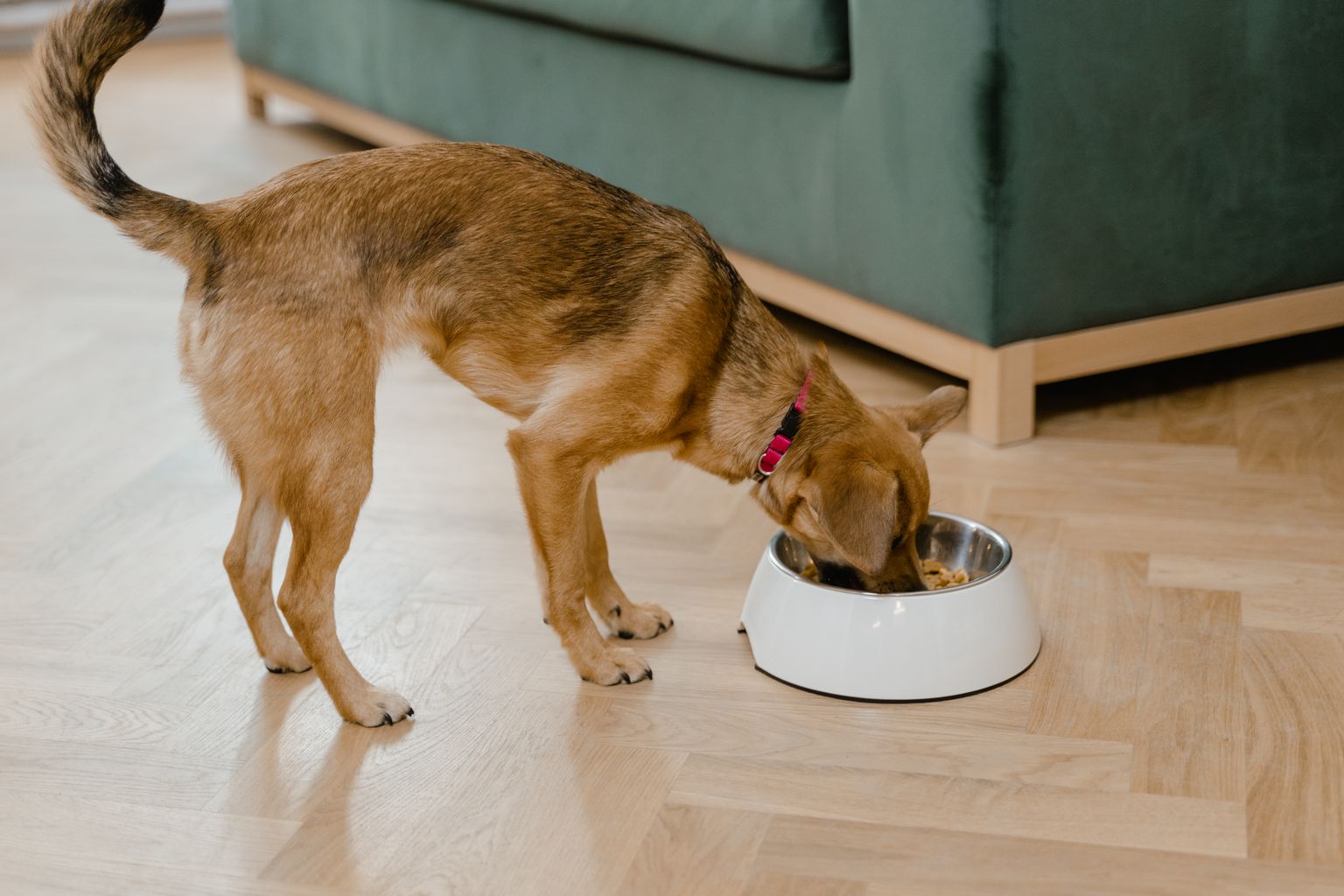
These estimates are based on your puppy’s current weight. Puppies under 4 months need about 3× their resting energy needs, and about 2× from 4 to 12 months.
| Current weight | Under 4 months (kcal/day) | 4–12 months (kcal/day) |
|---|---|---|
| 2 lb | ~195 | ~130 |
| 4 lb | ~330 | ~220 |
| 6 lb | ~445 | ~295 |
| 8 lb | ~550 | ~370 |
| 10 lb | ~655 | ~435 |
Formula: daily calories ÷ kcal per cup = cups per day.
Example: A 3-month-old, 4-lb puppy needs about 330 kcal. With a 400 kcal/cup food, that’s about 0.8 cup a day, or about 3 tablespoons per meal across 4 meals.
At these tiny amounts, a kitchen scale is more accurate than a scoop. Keep treats under 10% of daily calories.
Check body condition every 2 weeks. You should feel the ribs easily without seeing them, see a slight waist from above, and see the belly tuck up from the side. If the ribs are hard to find, cut food by about 10%. If the hips or spine look bony, add about 10% and tell your vet. The AKC notes obesity can take up to two years off a dog’s life, so good habits start now.
How often to feed a small-breed puppy
| Age | Meals per day | Notes |
|---|---|---|
| 8–12 weeks | 4 (toy breeds: 4–6) | No more than 4–5 hours without food during the day |
| 3–6 months | 3–4 | Toy breeds stay at 4+ until about 4 months |
| 6–9 months | 3 | Hypoglycemia risk is mostly past |
| 9–12 months | 2–3 | Move toward an adult routine |
A simple schedule for a young puppy is 7 a.m., 11 a.m., 3 p.m., and 7 p.m. Regular mealtimes also make house training easier.
Picky eater? Rule out teething or tummy trouble first. Then offer food for 20 minutes and pick it up until the next meal. Don’t do this with a toy puppy showing signs of low blood sugar; call your vet instead.
Dry vs. wet food
Dry food has more calories per bite, costs less, and is easy to measure. Wet food is softer for teething mouths and more appealing to poor eaters, but it spoils faster and has fewer calories. For many small puppies, the best setup is kibble with a spoonful of wet food mixed in. If you mix, subtract the wet food’s calories from the kibble portion.
Is grain-free food good for small-breed puppies?
For most puppies, grain-free has no proven benefit. In 2018 the FDA began investigating possible links between legume-heavy diets, many labeled grain-free, and dilated cardiomyopathy (DCM), a serious heart disease. In 2022 it said the evidence couldn’t prove a cause, but many veterinary cardiologists still advise caution. True grain allergies are rare. Choose grain-free only if your vet diagnoses a grain sensitivity.
When to switch to adult food
Most small breeds switch at 9–12 months, and toy breeds closer to 9–10 months. Spaying or neutering lowers calorie needs, so ask your vet about timing.
| Days | Old food | New food |
|---|---|---|
| 1–2 | 75% | 25% |
| 3–4 | 50% | 50% |
| 5–6 | 25% | 75% |
| 7 | 0% | 100% |
If stools turn soft, hold the current ratio for a few more days. Sensitive puppies may need 10–14 days. When you’re ready, see our guide to the best dog food for small dogs.
Common feeding mistakes
- Trusting the bag chart blindly. Bag charts often run high, so adjust by body condition.
- Measuring with a random cup. Kitchen cups can be 30% off.
- Skipping meals. For toy puppies, a missed meal can mean a blood-sugar crash.
- Too many treats. Use lentil-sized pieces or kibble from the daily portion.
- Sharing table food. Grapes, raisins, onions, garlic, chocolate, and xylitol are toxic.
- Switching foods suddenly. This is the most common cause of puppy diarrhea.
- Feeding right before crate time. Allow 30–60 minutes and a potty break before your puppy goes in. Our guide on how to crate train a dog covers the full routine.
- Mistaking teething for pickiness. Soften food and offer safe puppy chew toys.
The bottom line
The best puppy food for small breeds has an AAFCO growth statement, a named protein near the top, added DHA, and small, calorie-dense kibble from a maker that invests in nutrition science. Once you’ve found it, the routine matters just as much as the bag. Feed small meals often, measure portions by calories rather than by scoop, and check your puppy’s body condition every couple of weeks.
Watch toy breeds closely for signs of low blood sugar, and call your vet if anything seems off. Simple tools like a timed feeder, a slow-feed bowl, and a puppy chew toy make that routine easier to stick to. When your puppy reaches 9 to 12 months, move gradually to an adult formula. Our guide to the best dog food for small dogs will help you pick the next bag.
Frequently Asked Questions
What is the best food to feed a small puppy?
A complete and balanced small-breed or toy-breed puppy formula with an AAFCO growth statement, a named protein first, DHA, small kibble, and about 400+ kcal per cup.
What puppy food do vets recommend for small breeds?
Vets usually recommend small- or toy-breed puppy formulas from makers that employ veterinary nutritionists, run AAFCO feeding trials, and control quality in their own facilities. Ask your vet which options fit your puppy’s expected adult size.
How many meals a day does a small-breed puppy need?
Four until about 3–4 months (toy breeds may need 4–6), then 3 until 6–9 months, then 2–3 until adulthood.
Is a scrambled egg good for a puppy?
Yes, in small amounts. It must be plain and fully cooked, with no butter, salt, or seasoning. Count it toward the 10% treat limit.
Is wet or dry food better?
Both can be complete. Dry is more calorie-dense and affordable, while wet is easier for teething puppies. Many owners mix them.
When should I switch to adult food?
Usually at 9–12 months. Make the switch gradually over 7 days or longer.
