
Quick answer: No cat is 100% allergy-free, but hypoallergenic cat breeds either make less Fel d 1, the protein behind most cat allergies, or shed less of it. The Siberian and Balinese have the most evidence for lower allergen levels. Low-shedding breeds like the Devon Rex, Cornish Rex, Sphynx, and Bengal spread less dander. Always spend time with the actual cat before you adopt.
The fluffiest cat on this list, a Siberian with a thick triple coat, is also the breed allergic owners tend to do best with. That sounds backwards until you know what’s making you sneeze. Hypoallergenic cat breeds are cats that either make less Fel d 1, the protein behind most cat allergies, or shed less of it around your home. No cat is fully allergy-free, though. The Siberian and the Balinese have the most evidence for lower allergen levels, and even that evidence comes from small studies and owner reports.
Every cat is different too, so spend real time with the actual cat before you bring one home. Below you’ll find 12 breeds side by side, the cats to skip, and how to make a home work when you’re allergic.
Hypoallergenic Cat Breeds at a Glance
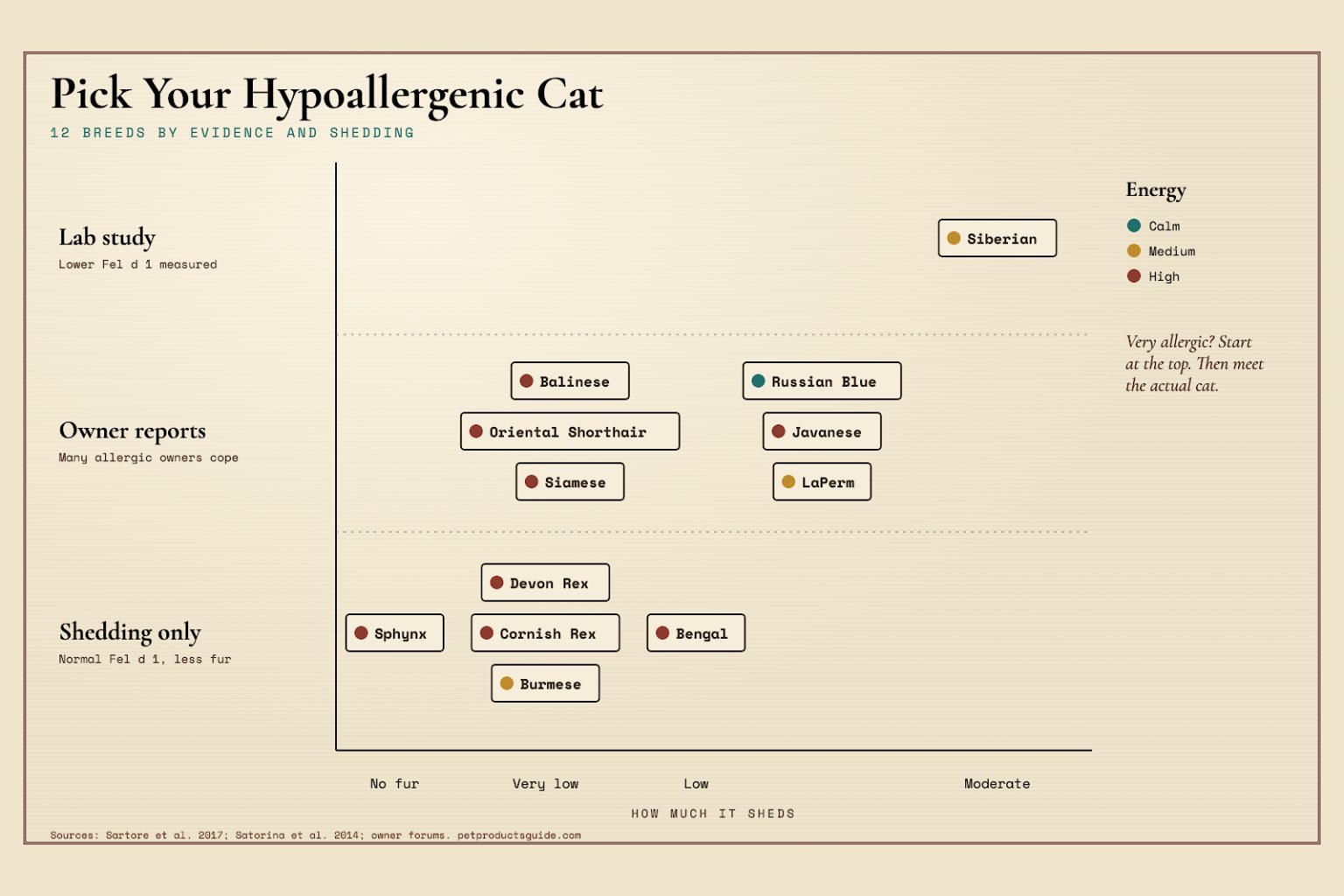
Read the evidence column first, because it tells you why each breed made the list.
- Study: A lab study found lower Fel d 1 in some cats of this breed.
- Owner reports: Lots of allergic owners say they react less, but no lab data backs it yet.
- Shedding only: The cat still makes normal Fel d 1, but its coat leaves less fur and dander around your home.
Very allergic? Start with the top two rows. Mild symptoms give you more room to pick by personality and energy.
| Breed | Coat | Shedding | Evidence for low allergen | Grooming | Energy | Typical US price |
|---|---|---|---|---|---|---|
| Siberian | Long, triple | Moderate, seasonal | Study + owner reports | 2-3 brushes a week | Medium | $1,200–$3,500 |
| Balinese | Long, single, silky | Low | Owner reports | Weekly brush | High | $1,000–$2,500 |
| Russian Blue | Short, dense double | Low | Owner reports | Weekly brush | Low to medium | $1,000–$3,000 |
| Bengal | Short, pelt-like | Low | Shedding only | Light | Very high | $1,000–$5,000 |
| Devon Rex | Short, wavy | Very low | Shedding only | Gentle wipe, ear cleaning | High | $1,200–$2,500 |
| Cornish Rex | Short, curly undercoat | Very low | Shedding only | Gentle wipe | Very high | $1,000–$2,500 |
| Sphynx | Hairless | None | Shedding only | Weekly bath | High | $1,500–$6,000 |
| Oriental Shorthair | Short, fine | Low | Owner reports | Weekly brush | High | $800–$2,000 |
| Javanese | Medium, silky | Low | Owner reports | Weekly brush | High | $800–$2,000 |
| Siamese | Short, fine | Low | Owner reports | Weekly brush | High | $600–$2,000 |
| LaPerm | Curly, short or long | Low | Owner reports | Weekly comb | Medium | $1,000–$2,000 |
| Burmese | Short, satin | Very low | Shedding only | Light | Medium to high | $1,000–$2,500 |
Typical pet-quality kitten prices from US breeders, checked November 2026. Show-quality kittens and rare colors cost more.
Are There Hypoallergenic Cats?
No, there’s no truly hypoallergenic cat. Every cat makes Fel d 1, so every cat can set off an allergy in someone sensitive enough.
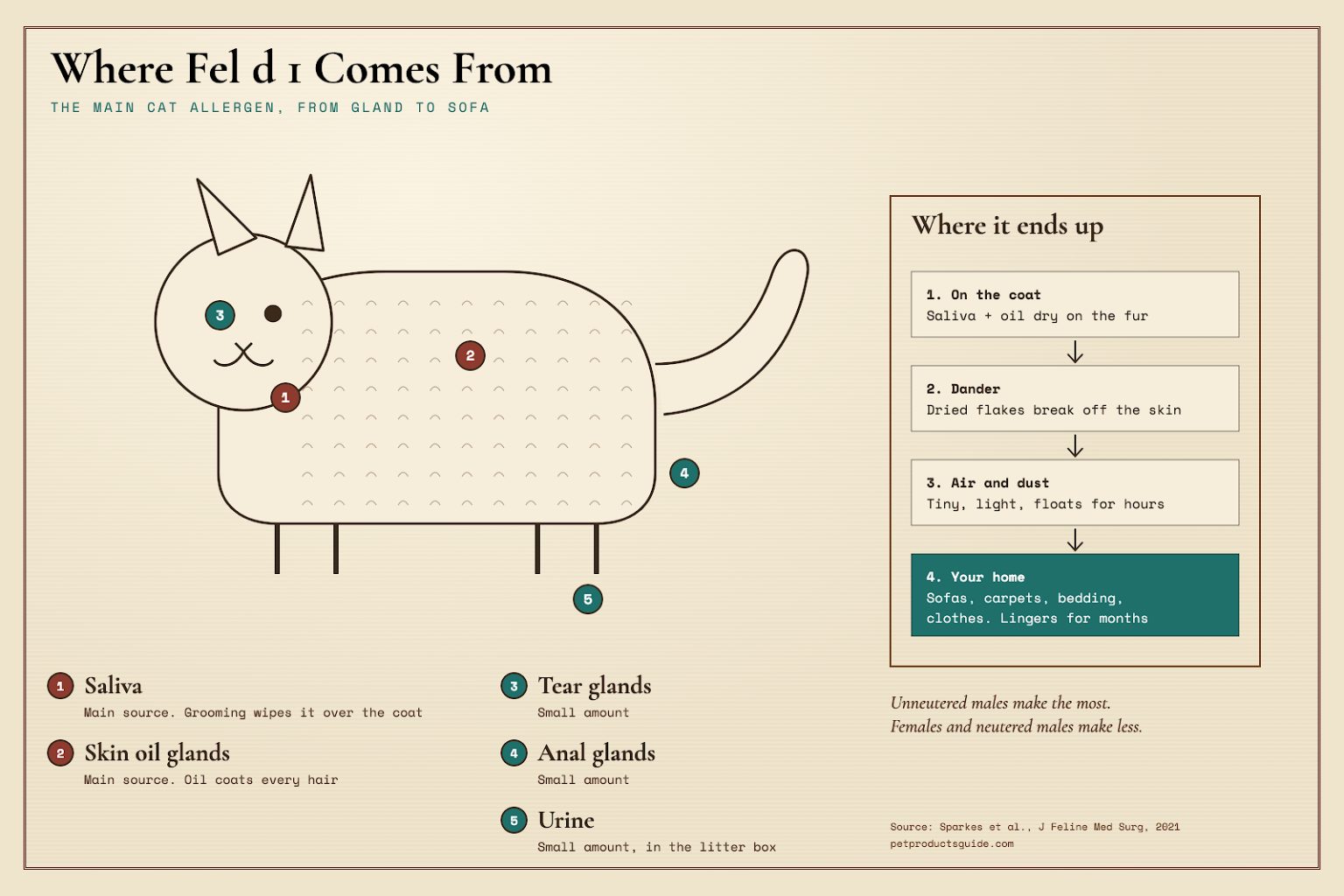
Here’s where it comes from. A 2021 review for vets by Dr. Andrew Sparkes and colleagues explains that Fel d 1 is made mainly in a cat’s saliva and in the sebaceous (oil) glands of its skin. When your cat grooms, its rough tongue spreads saliva across the whole coat. That saliva dries into flakes of dander that float in the air and cling to couches, carpets and clothes for months.
So why do some cats bother you less? Three reasons:
- Some cats make less Fel d 1. Levels vary a lot from cat to cat, even within one breed.
- Some coats spread less of it. A 2014 study found cats sold as hypoallergenic carried less Fel d 1 on the fur of their face and chest than ordinary cats.
- Sex and neutering change the amount. More on that further down.
The same 2021 review notes that most breed claims rest on owner reports rather than lab data. That’s why meeting the individual cat is the step that counts most.
12 Best Hypoallergenic Cat Breeds
These 12 hypoallergenic cat breeds run from the best-studied down. Each one covers why it made the cut, grooming, personality, who it suits, and what a US breeder charges.
Siberian
The Siberian has the strongest evidence of any breed. A 2017 study of Siberian cats found gene changes linked to Fel d 1, and the one cat carrying them had far less allergen in its saliva.
- Coat and grooming: A thick triple coat that drops a lot in spring and fall. Brush two or three times a week.
- Personality: Calm, playful, and often follows you room to room like a dog.
- Who it suits: Families and anyone who wants a big, cuddly cat.
- Price: $1,200 to $3,500.
Some breeders test their kittens’ Fel d 1 levels, so ask for results.
Balinese
Often called the long-haired Siamese, the Balinese is the other breed researchers point to for lower Fel d 1, with plenty of support from breeders and allergic owners.
- Coat and grooming: A silky single coat with no woolly undercoat, so it rarely mats. One brush a week does it.
- Personality: Chatty, affectionate, and always near the action.
- Who it suits: People who are home a lot and want a talkative shadow.
- Price: $1,000 to $2,500.
Russian Blue
Allergic owners often report milder symptoms around Russian Blues. Their dense, plush double coat keeps dander close to the skin instead of scattering it.
- Coat and grooming: Short and thick, with light shedding. Brush weekly.
- Personality: Gentle and quiet, shy with strangers but devoted to its people.
- Who it suits: Calm homes, apartments, and first-time cat owners.
- Price: $1,000 to $3,000.
Bengal
The Bengal is here for its short, pelt-like coat, which sheds very little dander-coated hair.
- Coat and grooming: Sleek. A quick rub with a grooming mitt is enough.
- Personality: Very high energy, clever, and a climber. Many love water.
- Who it suits: Active owners who’ll play every day and invest in tall cat trees.
- Price: $1,000 to $5,000.
Devon Rex
The Devon Rex has a short, wavy coat that sheds very little, so fewer allergen-coated hairs reach your furniture.
- Coat and grooming: Fragile curls that break if you brush hard. Wipe with a soft cloth instead, and clean the oversized ears weekly.
- Personality: Playful, cheeky, and happiest on your shoulder.
- Who it suits: People who want a cat that acts like a sidekick.
- Price: $1,200 to $2,500.
One rescuer on TheCatSite forum shared that Devons made her sick while Cornish Rexes didn’t, which shows how personal reactions can be.
Cornish Rex
The Cornish Rex has only the soft, curly undercoat most cats wear under their top coat, and it barely sheds.
- Coat and grooming: Very fine. A cloth wipe works better than a brush.
- Personality: Athletic, goofy, and people-focused. It loves fetch.
- Who it suits: Busy households with time for play.
- Price: $1,000 to $2,500.
Sphynx
No fur means no shedding, which is why the Sphynx makes almost every list. The catch is that its skin oils still carry Fel d 1.
- Coat and grooming: Hairless and oily. Bathe it about once a week, plus ear cleaning, or the oil builds up on your sheets.
- Personality: Warm, clingy, and a born entertainer.
- Who it suits: Owners happy with a weekly bath routine and a heated cat bed.
- Price: $1,500 to $6,000.
Oriental Shorthair
This Siamese relative has a short, fine coat that sheds lightly, and allergic owners often cope well with it.
- Coat and grooming: Close-lying and easy. Brush weekly.
- Personality: Loud, curious, and very social. It doesn’t like being left alone all day.
- Who it suits: Homes where someone is around, or that already have a second pet.
- Price: $800 to $2,000.
Javanese
The Javanese is a close cousin of the Balinese (some registries now group them), and owners report the same easier allergy experience.
- Coat and grooming: Medium-length and silky with no undercoat. Brush once a week.
- Personality: Talkative, smart, and devoted to one person.
- Who it suits: Someone who wants a chatty companion with a pretty coat.
- Price: $800 to $2,000.
Siamese
The Siamese sheds lightly thanks to its short, fine coat, and plenty of allergic owners do well with one.
- Coat and grooming: Sleek and low-fuss. A weekly brush is plenty.
- Personality: Vocal, loyal, and bonds closely with its family.
- Who it suits: People who want a cat that talks back.
- Price: $600 to $2,000.
LaPerm
The LaPerm is a rare curly-coated breed many lists skip. Its loose curls shed lightly, and owners with mild allergies often do well with it.
- Coat and grooming: Short or long ringlets. Comb weekly and avoid heavy brushing, which flattens the curls.
- Personality: A gentle lap cat that still enjoys a good play session.
- Who it suits: Patient buyers, since US breeders often run waitlists.
- Price: $1,000 to $2,000.
Burmese
The Burmese has a short, satin-like coat that sheds very little, so less fur and dander end up on your floors.
- Coat and grooming: Minimal. A damp hand or chamois brings out the shine.
- Personality: Sociable, playful, and great with kids and other pets.
- Who it suits: Families who want a sturdy, friendly cat.
- Price: $1,000 to $2,500.
Which Cat Is the Most Hypoallergenic?
The Siberian and the Balinese are the most hypoallergenic cats, based on what we know today. They have the lab findings and the deepest pile of owner reports.
Still, the breed only raises your odds. Fel d 1 levels vary so much from cat to cat that a low-allergen Siberian and a high-allergen Siberian can land at opposite ends of the scale. Owners in r/SiberianCats describe reacting to one Siberian and feeling fine around another.
Treat the breed as your shortlist, then test yourself with the individual cat.
Are Male or Female Cats Better for Allergies?
Female cats and neutered males are better for allergies. Unneutered males make the most Fel d 1, because testosterone pushes production up.
The 2021 vet review linked above confirms that intact males produce more Fel d 1 than neutered males or females. An earlier study from 1996 found the same pattern when it compared male and female cats.
So pick a female or a neutered male. Most shelters and breeders neuter before adoption, so the cat to watch for is an intact breeding male you meet while visiting a cattery.
Worst Cats for Allergies
The worst cats for allergies are heavy shedders with long or very dense coats. They don’t always make more Fel d 1 than hypoallergenic cat breeds, but their fur spreads it everywhere.
- Persian: A long, thick coat that sheds all year and needs daily brushing, which throws dander into the air.
- Maine Coon: A huge, shaggy cat with big seasonal sheds.
- Himalayan: The Persian’s long, dense coat and constant grooming.
- British Shorthair: A short but very thick coat that drops a surprising amount of hair.
How to Live With a Cat When You Have Allergies
Living with a cat when you’re allergic works best when you plan before adoption day, then cut allergen at home every week.
Before You Adopt
- See an allergist first. A skin or blood test confirms whether it’s really cats you react to.
- Do a trial visit or foster. Spend a few hours with the actual cat, ideally more than once. Owners in r/CatAdvice say this is the only test that told them anything.
- Meet the cat you’ll take home, not just the breeder’s other cats.
If you’re bringing home a young cat, read up on how to take care of a kitten so the first weeks go smoothly for both of you.
At Home
- Run a HEPA air purifier in the rooms your cat uses most.
- Keep one cat-free bedroom. It gives your body a break every night and is a big part of a pet-friendly home that also works for you.
- Wash bedding weekly in hot water, plus throws and cat beds.
- Brush your cat outside, or have a non-allergic family member do it. It’s one of the easiest ways to prevent pet hair from coating your furniture.
- Use low-dust litter. Several of the best cat litter for odor control options are also low-dust clumping formulas, and sticking to a schedule for how often to change cat litter keeps dust from building up.
- Deep-clean fabrics often. The same steps you’d use to remove pet odor from carpets and couches also lift allergen-coated dander.
Allergen-Reducing Cat Food
Purina’s Pro Plan LiveClear is coated with an egg-based protein that binds Fel d 1 in your cat’s saliva. Purina says it cuts the allergen in cat hair and dander by an average of 47%, starting in the third week of daily feeding.
It has limits: that’s an average, so some cats drop less, and it doesn’t touch dander already in your home. If your cat is indoor-only, compare LiveClear with other best cat food for indoor cats picks.
How Much Does a Hypoallergenic Cat Cost?
A hypoallergenic cat from a US breeder usually costs $800 to $3,500 for a pet-quality kitten. Bengals and Sphynx cats can reach $5,000 or more, while Siamese and Oriental Shorthairs cost the least.
Adoption is the cheaper route. Shelter fees usually run about $75 to $300 and often include spaying, vaccines, and a microchip. Breed rescues for Siamese, Bengals, and Sphynx cats regularly rehome adults, and you can search by breed on Petfinder.
What about the “$100,000 cat”? That’s the Ashera, launched in 2007 as a rare hypoallergenic hybrid and advertised at $75,000 to $125,000. HowStuffWorks reports that DNA testing in 2008 identified the cats as Savannahs, and no major registry recognizes the Ashera. No cat at any price is allergy-free.
When to See a Doctor About Cat Allergies
See a doctor if your cat allergy shows up as more than sneezing and itchy eyes. Book an appointment if you notice:
- Wheezing or a tight chest
- Shortness of breath
- Symptoms that don’t ease after you leave the cat’s space
- Hives or a rash after touching a cat
An allergist can test you and talk through treatment options. This guide is general information, not medical or veterinary advice; see our disclaimer for details.
The Bottom Line
The Siberian and Balinese give allergic owners the best odds, and the low-shedding hypoallergenic cat breeds widen your choices. Shortlist two or three, then book a trial visit with the actual cat, and keep our cat care guides handy once your new cat settles in. A few hours together tells you more than any breed list.
Frequently Asked Questions
Is there a 100% hypoallergenic cat?
No. Every cat makes Fel d 1. Some breeds make less or shed less of it, which can mean fewer symptoms.
Do hypoallergenic cat breeds shed?
Most do, just less. The Sphynx has no fur to shed, but its skin oils still carry allergens.
What is the best cat for allergies and asthma?
The Siberian and Balinese have the most evidence for lower Fel d 1. With asthma, talk to your doctor before any trial visit.
What are the best hypoallergenic cats for families with kids?
The Siberian, Burmese, and Siamese are patient, playful, and good with children.
What is the cheapest hypoallergenic cat?
A Siamese or Oriental Shorthair from a rescue is usually cheapest, often under $300 including vaccines.